Port-Cros: How Europe's Oldest Marine National Park Became the Mediterranean's Most Pristinely Protected Island Luxury
March 28, 2026 · 13 min read
The first thing you notice about Port-Cros is the silence. Not the relative silence of a quiet beach or a country road, but a silence of such depth and completeness that it recalibrates your auditory expectations within minutes of stepping off the ferry. There are no cars on Port-Cros — no roads, in fact, in the conventional sense. No motorbikes, no generators, no air conditioning units humming on exterior walls. The only sounds are those that the island itself produces: wind in the Aleppo pines, waves on the rocky shore, birdsong of extraordinary variety and volume, and the occasional distant throb of a boat engine crossing the strait from the mainland. This silence is not an absence but a presence — the acoustic signature of an island that has been protected, with absolute rigour, since 1963, when Port-Cros became Europe's first national park to encompass both terrestrial and marine environments.
The Îles d'Hyères: The Golden Archipelago
Port-Cros is the smallest and most mountainous of the three main Îles d'Hyères — also known as the Îles d'Or, the Golden Islands, a name bestowed either by sixteenth-century cartographers impressed by the golden glow of the mica-flecked rocks at sunset or, less romantically, by the gold coins that Saracen pirates are said to have cached on the islands during their medieval raids on the Provençal coast. The archipelago — comprising Porquerolles (the largest and most visited), Port-Cros (the wildest), and the Île du Levant (partially a military base, partially a naturist colony) — lies approximately fifteen kilometres off the coast between Toulon and Le Lavandou, close enough to see from the mainland but far enough to feel genuinely insular.
Of the three, Port-Cros is the one that most fully justifies the journey. Porquerolles, beautiful as it is, has been partially domesticated: it has a village with restaurants and shops, bicycle rental outlets, and vineyards that produce drinkable rosé. Port-Cros has almost none of this. The island's only commercial establishments are a single restaurant at the port (open seasonally), a small information kiosk staffed by park rangers, and a handful of buildings that serve the national park's administrative and research functions. Everything else is nature — 690 hectares of terrestrial park and 1,800 hectares of surrounding marine reserve, protected with a rigour that makes Port-Cros not merely a national park but a controlled experiment in what the Mediterranean looks like when human interference is systematically minimised.
The Underwater Trail: Snorkelling Through Time
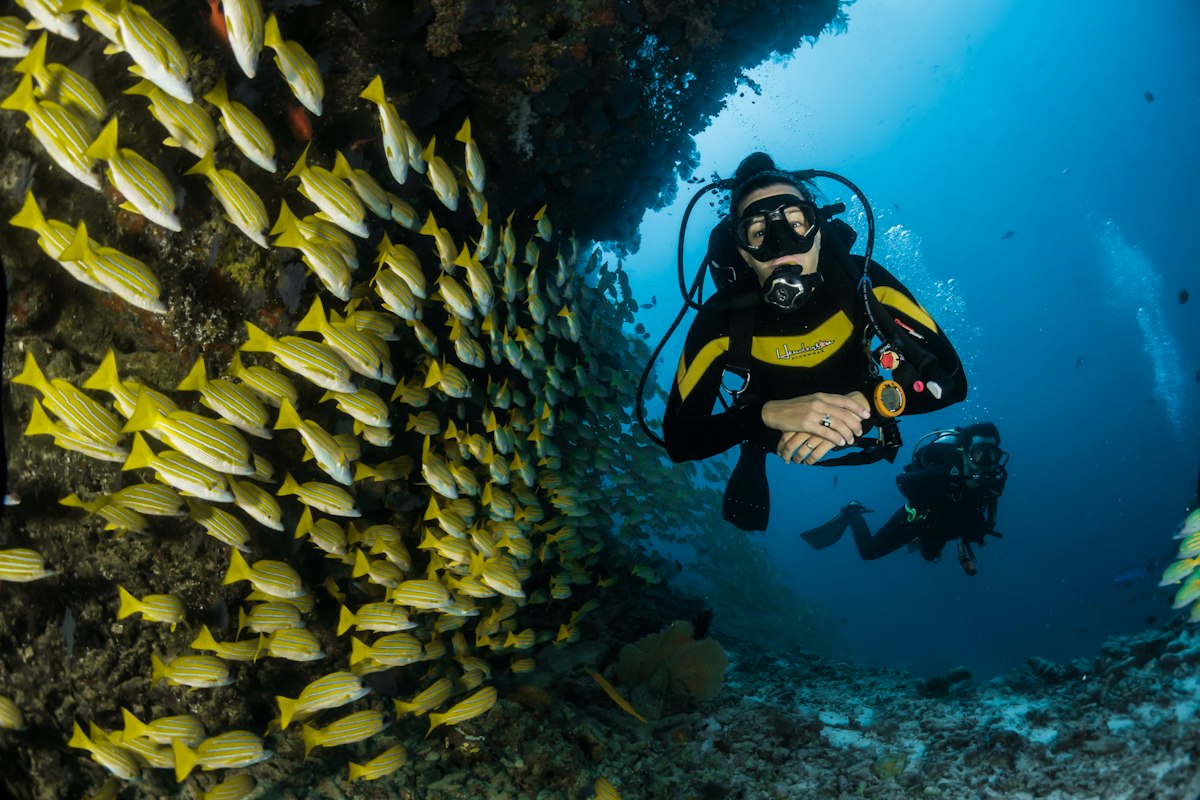
The Sentier Sous-Marin de la Plage de la Palud — the underwater trail at La Palud beach, on the island's northern coast — is Port-Cros's most celebrated visitor experience and one of the most remarkable snorkelling sites in the Mediterranean. The trail, established in 1979 and the first of its kind in Europe, follows a marked route of approximately 300 metres through water ranging from one to six metres in depth, passing over posidonia meadows, around rocky outcrops colonised by sponges and sea fans, and through zones where the density of marine life — grouper, sea bream, rainbow wrasse, barracuda, moray eels, and octopus — is visibly, dramatically greater than anything found in the unprotected waters nearby.
Six underwater information panels, weighted to the seabed and covered with laminated illustrations, identify the principal species and habitats along the route. The effect is of an underwater museum whose exhibits are alive — a guided tour through an ecosystem that, after six decades of protection from fishing, anchoring, and pollution, has achieved a state of biological richness that marine ecologists consider a baseline reference for what the Mediterranean was like before industrial-era human impact. To snorkel the trail at La Palud is to experience, for twenty or thirty minutes, a version of the sea that has otherwise vanished from all but the most remote corners of the basin.
The Forest: A Mediterranean Climax
Port-Cros's terrestrial environment is scarcely less remarkable than its marine one. The island's interior is covered by dense, mature forest — primarily Aleppo pine, holm oak, and strawberry tree (arbutus) — that represents one of the last examples of Mediterranean climax forest on the French coast. Climax forest is the ecological term for a forest that has reached its maximum state of biological complexity and self-sustaining equilibrium — a state that, on the mainland, centuries of logging, grazing, and development have rendered almost impossible. On Port-Cros, protected from human exploitation for over sixty years, the forest has achieved a density, a height, and a structural complexity that give the visitor a visceral sense of what the entire Provençal coast once looked like.
The hiking trails — there are four principal routes, ranging from forty-five minutes to three hours — penetrate this forest with minimal intervention. The paths are maintained but unpaved, following the island's ridges and contours through a landscape that changes character with altitude and aspect: the south-facing slopes are drier, covered with the aromatic scrub — myrtle, lentisk, cistus — that characterises the Mediterranean garrigue; the north-facing slopes are damper, darker, the forest canopy so dense that the ground beneath is carpeted with ferns and mosses that belong more to an Atlantic woodland than a Mediterranean island. At the summit of Mont Vinaigre (196 metres), the highest point, the view encompasses the entire archipelago, the coastal massif of the Maures, and on clear days the distant peaks of the Alpes Maritimes.
The Birds: Yelkouan and Cory's
Port-Cros is one of the most significant breeding sites in the western Mediterranean for the Yelkouan shearwater (Puffinus yelkouan), a pelagic seabird whose eerie nocturnal calls — a series of wailing, almost human cries — echo from the island's cliffs after dark and constitute, for those who spend the night on or near the island, an auditory experience of haunting beauty. The island also hosts breeding colonies of Cory's shearwater, the European storm petrel, and the Audouin's gull — species whose populations have declined across most of the Mediterranean but which find in Port-Cros's protected cliffs and absence of introduced predators the conditions for successful reproduction.
During migration seasons — spring and autumn — the island becomes a waypoint for hundreds of species crossing the Mediterranean, and the national park's ornithological monitoring programme has recorded over 140 bird species on the island's small area. For the birdwatcher, Port-Cros offers the rare experience of observing Mediterranean avifauna in a habitat that has not been degraded by development, light pollution, or noise — conditions that produce not merely higher species counts but more natural behaviours, as birds on Port-Cros exhibit a tameness born of safety that has largely disappeared from the mainland.
The Forts: Military Heritage in Wilderness
Port-Cros's strategic position at the approaches to the French naval base at Toulon has given it a military history disproportionate to its size. The island is crowned by three forts — Fort de l'Estissac near the port, Fort du Moulin on the central ridge, and Fort de Port-Man on the southern coast — built at various periods between the seventeenth and nineteenth centuries to defend the roadstead against Ottoman, English, and Spanish attack. These structures, partially ruined but still imposing, provide architectural counterpoints to the natural landscape — their massive stone walls and vaulted interiors offering shelter and shade along the hiking trails.
Fort de l'Estissac, the most accessible, has been restored by the national park and serves as an exhibition space during the summer season, with displays on the island's ecology, history, and conservation efforts. The view from its terrace — encompassing the port, the forested hills of the island's interior, and the sparkling channel to the mainland — provides one of the finest panoramic experiences on any Mediterranean island.
Visiting: The Rules of Paradise
Port-Cros's protection comes with constraints that the luxury traveller should understand not as limitations but as the price of admission to a genuinely pristine environment. Smoking is prohibited throughout the island (fire risk in the dry forest). Dogs are not permitted. Camping is forbidden. Picking flowers, collecting shells, and removing any natural material is prohibited. The underwater trail requires no booking, but access is limited during peak summer months to manage environmental impact. Boats may anchor only on designated buoys; dropping anchor on the seabed is strictly forbidden to protect the posidonia meadows.
Ferries operate from Le Lavandou and Hyères port (approximately thirty to sixty minutes depending on service), with multiple daily departures during summer and reduced schedules in spring and autumn. Winter access is limited and weather-dependent. The single restaurant at the port serves simple but well-prepared Provençal cuisine — grilled fish, salads, the local rosé — at prices that, by Riviera standards, remain reasonable. Bring water, sun protection, good walking shoes, and snorkelling equipment. Bring nothing else but attention.
Published by Riviera Latitudes · Part of the Latitudes Media network