Montauroux: How the Var's Most Architecturally Layered Village Became the Lac de Saint-Cassien's Most Distinguished Lakeside Luxury Address
April 4, 2026 · 14 min read
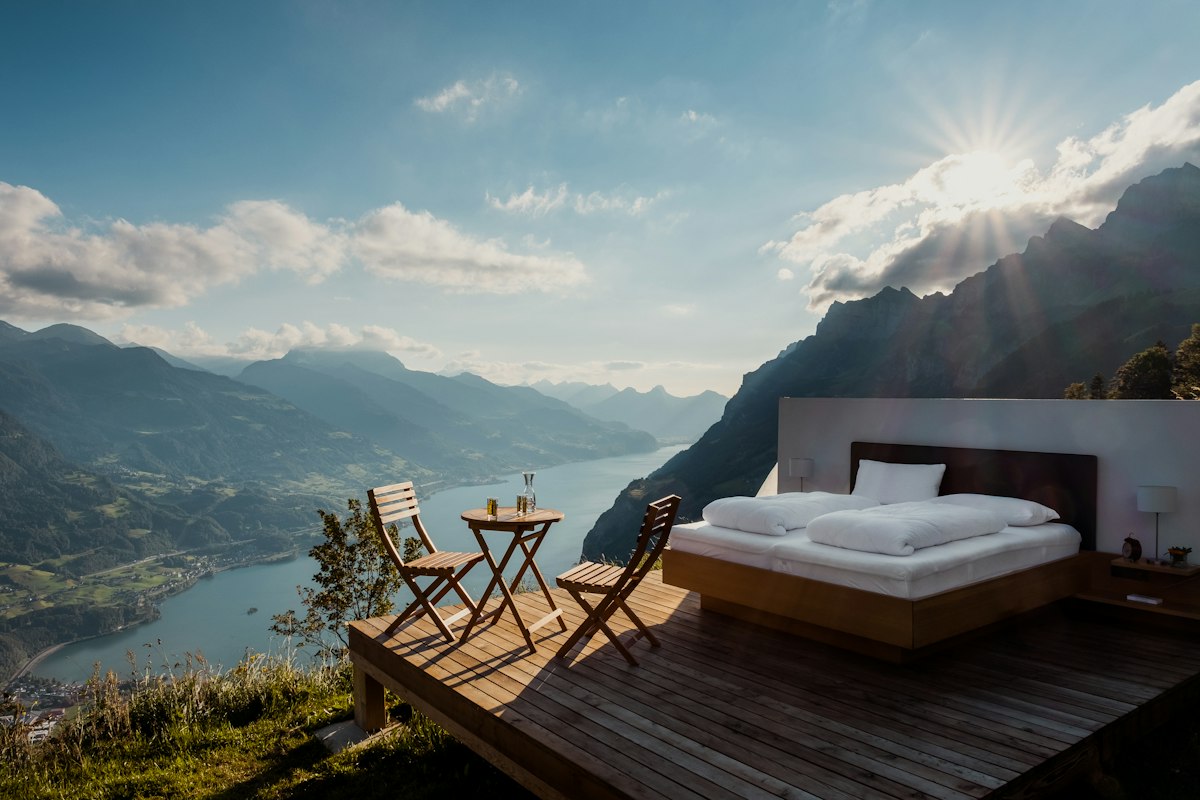
The approach to Montauroux from the south — from the lake road that skirts the western shore of Saint-Cassien — is an exercise in temporal compression. In the space of three kilometres, the landscape transitions from a 1960s-era reservoir framed by maritime pines to a Romanesque chapel dating from the 11th century, past the arches of an 18th-century Roman-style aqueduct, and finally into a medieval village whose Place du Clos still hosts a Thursday market that has operated, in one form or another, since the feudal era. Montauroux does not merely contain history; it displays it in geological strata, each layer visible from the one above, each century legible in stone.
The Dior Connection
Christian Dior's relationship with Montauroux began in 1950, when the couturier — already the most famous designer in the world, his "New Look" having restructured both fashion and femininity three years earlier — purchased the Château de la Colle Noire, a 19th-century bastide set within 120 hectares of olive groves and lavender fields on the commune's southern slope. Dior's biographers have offered various explanations for this choice: the light, the proximity to Grasse (whose perfumers supplied his fragrance line), the desire for seclusion. But the most plausible explanation is the simplest: Montauroux looked like the Provence of Dior's imagination — a landscape that confirmed the aesthetic he had been constructing in fabric and selling to the world.
Dior spent the last seven years of his life renovating and gardening at La Colle Noire with an obsessiveness that his staff found alarming and his friends found endearing. He designed the gardens himself, planting roses, jasmine, and the grey-green herbs — thyme, rosemary, lavender — whose aromatic profile would inform his fragrance house for decades after his death. The property, now owned by LVMH and restored to Dior's original vision, is not open to the public but its influence on Montauroux's cultural identity is pervasive. The village that Dior chose has become, by association, a village of taste — a designation that attracts a buyer profile seeking exactly the qualities the couturier valued: authenticity, discretion, and beauty that does not announce itself.
The Aqueduct of Mons
The most visually striking structure in the commune is not in the village at all. The Aqueduct of Mons — a 42-kilometre canal system built in the 1st century AD to supply water from the Siagnole springs to the Roman city of Forum Julii (modern Fréjus) — crosses the commune's eastern territory in a series of arched bridges and tunnels that remain, after two millennia, among the finest examples of Roman hydraulic engineering in Provence. The most spectacular section, the Pont des Tuves, spans a ravine near the village of Mons with an elegance that makes the modern infrastructure visible elsewhere in the commune — electricity pylons, telecommunications towers — appear both temporary and inadequate.
The aqueduct's presence in the landscape serves as a perpetual reminder that this territory has been valued — strategically, agriculturally, aesthetically — since antiquity. The Romans did not build 42 kilometres of precision-engineered masonry for a marginal location. They built it for a landscape that produced exceptional water, exceptional crops, and exceptional living conditions. That the same landscape now produces exceptional property values is less a modern phenomenon than a continuation of a two-thousand-year-old assessment.
The Lake: A Modern Amenity with Ancient Calm
Lac de Saint-Cassien was created in 1966 when EDF dammed the Biançon river to generate hydroelectric power and provide water to the eastern Var. The resulting reservoir — 430 hectares, with a shoreline of 25 kilometres — was an engineering project that inadvertently produced a landscape amenity of extraordinary quality. The lake's northern shore, bordered by Montauroux's communal forests, offers swimming, kayaking, and fishing in water so clean that it supports a population of European pond turtles — a species that tolerates no compromise in water quality.
The lake has transformed Montauroux's microclimate as much as its landscape. The body of water moderates summer temperatures by two to three degrees relative to the surrounding plateau, producing evenings of a coolness that the coast — where concrete retains the day's heat long past midnight — cannot match. This thermal effect, combined with the lake's capacity to generate morning mists that diffuse the Provençal light into something closer to Impressionist painting than Mediterranean postcard, has created an atmospheric environment unique in the region. Montauroux's light is softer than Cannes's, more complex than Saint-Tropez's, and — in the opinion of the artists who have settled here — more interesting than both.
The Property Market: Three Tiers
Montauroux's real estate market operates across three distinct tiers, each serving a different buyer profile and offering a different version of Provençal luxury. The village core — medieval and early-modern houses arranged around the Place du Clos and the Église Saint-Barthélémy — commands €4,000-€6,500 per square metre. These are properties of character: thick walls, exposed beams, interior courtyards too small for swimming pools but perfect for dinner parties. Their buyers tend to be French, typically Parisian, seeking a pied-à-terre that provides the sensory experience of Provence without the maintenance burden of a large estate.
The second tier — villas and bastides on the hillsides between the village and the lake — represents the commune's core luxury market. Properties here, typically on half-hectare to two-hectare parcels with pools, olive groves, and views toward the Esterel or the lake, trade between €800,000 and €3 million. The buyer profile is international: British, Scandinavian, Dutch, German, with a growing contingent of Americans attracted by the Dior association and the commune's absence from mass-market tourism narratives.
The third and most exclusive tier comprises the large domaines — estates of five hectares or more, often incorporating working agricultural elements (olive groves, vineyards, lavender fields) alongside residential facilities of considerable ambition. These properties, of which perhaps twenty exist within the commune, rarely appear on the open market. When they do, they command €3 million to €8 million and attract a buyer profile that has typically exhausted the coastal market's capacity to surprise and seeks, in the hinterland, a form of luxury that is productive as well as consumptive — land that does something as well as being something.
The Thursday Market and Communal Life
Montauroux's Thursday market, held on the Place du Clos, is smaller and more intimate than those of its more famous neighbours Fayence and Callian. This scale is its virtue. The market comprises perhaps thirty stalls — vegetables, cheeses, olives, honey, rotisserie chickens, a fishmonger who drives up from Fréjus before dawn — arranged with a spatial logic that encourages circulation rather than crowding. The market is where Montauroux's social life crystallises: where the French year-rounders, the international seasonal residents, and the occasional Parisian weekender encounter one another over crates of early-season strawberries and the region's distinctive rosé.
Beyond the market, Montauroux's communal life is sustained by the kinds of institutions that coastal resort towns have largely lost: a functioning primary school, a municipal library, a boulodrome where evening pétanque games draw spectators as well as players, and a calendar of fêtes that includes the August patronal celebration, the November olive harvest, and the December truffle market. These institutions are not preserved for touristic purposes. They exist because Montauroux remains, despite its growing international reputation, a working village — a place where people live full lives rather than visiting partial ones.
What Montauroux offers — and what distinguishes it within the Fayence country's increasingly competitive luxury market — is the convergence of cultural pedigree, natural amenity, and communal authenticity. The Dior connection provides the narrative that international buyers require. The lake provides the lifestyle amenity that families demand. And the village itself — medieval, market-centred, architecturally coherent — provides the authenticity that no amount of resort development can simulate. In Montauroux, luxury is not a layer applied to the landscape. It is the landscape itself, accumulated over centuries and available, still, to those who know where — and how slowly — to look.
About Riviera Latitudes
Riviera Latitudes is a premium digital publication exploring luxury, heritage, and lifestyle along the French and Italian Riviera. Part of the Latitudes Media network.